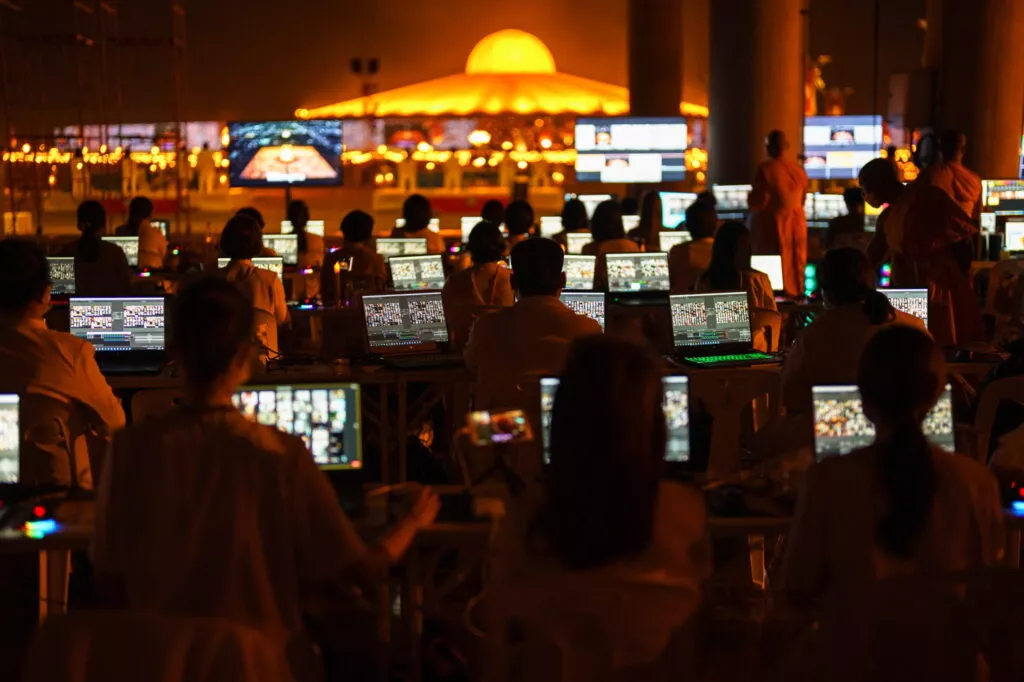
Source: Charting a responsible AI transition for Southeast Asia’s workforce | East Asia Forum
Reading the above EAF article, I can sense that these generalists have no idea what it takes to be AI brains. They think up-skilling and re-skilling software engineers will make them AI brains, just like most software engineers in Korea.
South Korea did so from 2017 to 2022, under President Moon JaeIn. His administration, at my reasonable guess, must have spent at least US$100 billion for up- and re-skillling alone, be it just for monetary support for coding camps or government-funded projects to Korean IT companies.
I want to go a bit higher than $100 billion, but it’s better to avoid any controversy, so let’s keep that conservative number.
No one in Korea now is talking about Korea’s chances in the middle of US-China tech war. Koreans now see that there is no future for Korea to compete in this AI league. They know that they don’t have experts, and the tax money has been used for meaningless projects. For the last 8 years, I don’t think the country has trained qualified AI brains who can at least pass SIAI’s undergraduate program’s admission exam. Indeed, policy missteps under the previous administration resulted in irrecoverable structural inefficiencies.
The Korean authority thought that software engineers could become AI experts, if they have little more AI-specialized training. They also thought the IT projects with a deep learning’s coding library qualifies to be an AI project.
People like me, claiming that the budget has to be given to graduate schools for computational scientific studies, which are tools used by not only a few cutting-edge engineering R&D, but also by natural science, social science, and even by language departments, were completely shadowed by the public.
My approach was consistently misaligned with prevailing domestic incentives, which reinforced my decision to disengage from the local market.
I gave up fighting for it in 2020, and folded Korean business in 2022. Since then, I have never looked back, because I know that Korea has absolutely no chance to rise in this field.
Without mathematically trained modelers, whatever they do with AI modules and libraries, it is no more than copying codes from github to your server. When your data set is different, when your purpose is different, and when your business is different, it is no use, at all. It’s like you use trigonometry formula to solve log / exponential functions, if I use high school math terms. Or, let’s say that it’s just hoping that K-pop can be universally accepted form of high-end music, when the audiences are highly sophisticated experts for orchestra.
Most professors from top engineering departments cannot even touch stochastic dynamic optimization models, the popular name of which is probabilistic reinforcement learning, in case the latter term is more familiar to AI researchers. Just in case, it’s the math modeling technique that is the central part of ChatGPT like LLM services. I did MSc Economics and PhD in Mathematical Finance for my graduate studies, and I remember solving stochastic dynamic optimization problems in the MSc Econ’s math camp. Disqualified classmates were sent to easier majors like sociology or business economics. During my PhD, I was a TA for stochastic calculus courses, which were the first two courses given to new MSc Math Finance students. In other words, it’s a gateway level knowledge for grad schools in the western top schools, but not that many Korean engineering professors can solve even the basic problem sets.
Still, the engineering professors have enjoyed hard monopoly on all ‘AI’ projects by the government as well as by large Korean conglomerates. IT companies have thousands of ‘AI experts’, who have no idea what the dynamic optimization really is. They just blindly copied and pasted github codes, AI libraries, and AI modules. After US$100 billion for 5 years, is there any AI stack from Korea that global AI experts use now?
I just hope that Southeast Asia do not make the same mistake.
I am not a political activist, but for this issue alone, I think of the case as one of the most extremely noteworthy mis-guided tech policy decisions in the modern history of Korea, a comparable mis-step in policy of which is hard to find in any historic references. President Moon’s poor decision has put the country like 10 years backward. If the money was placed at the right department and the right people, Korea must be now a good candidate for the so-called 3rd AI Stack. Not that many countries in the world have invested over $100 billion just for training AI brains.
I am building the 3rd AI stack in Swiss, and whenever I get questions if there is any possibility that I defect back to Korea and Korea rises as a 3rd AI stack candidate in the next 5 years, I tell them what really happened in Korea from 2017-2022. I also tell them that the local market’s perception of AI has not changed at all, because the monopolists are still there and still usurping money without any expertise.. Then, my team just strikes out Korea from the potential competitor list. They are also sure that I won’t even considering going back.