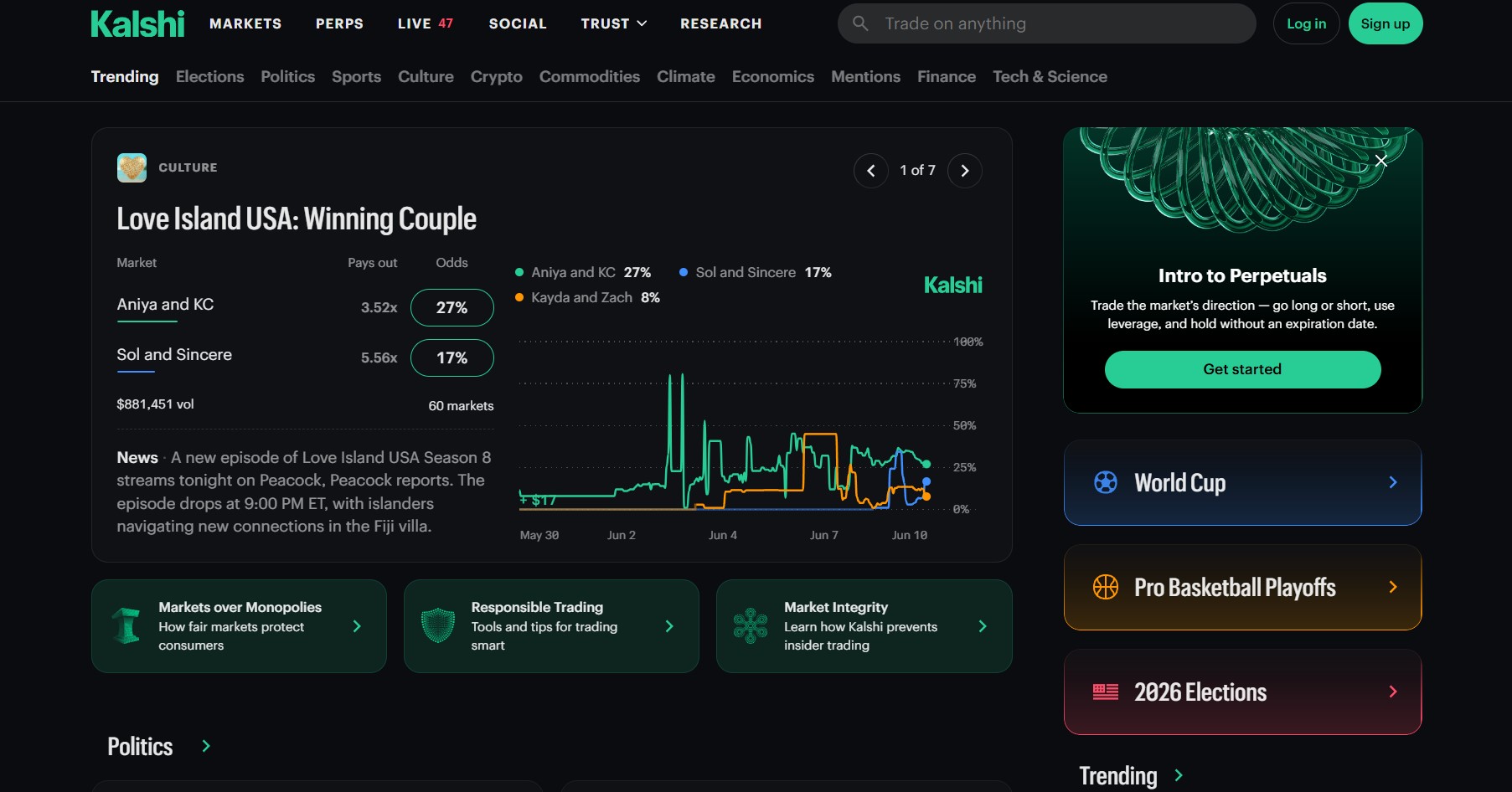
Source: Kalshi - Prediction Market for Trading the Future, June 10th, 2026 (EST)
This article is inspired by How prediction markets could forecast the future of science | Scientific American.
It was just another gloomy day in London, back in 2012. Professor Hoyong Choi from KAIST, then a 2nd-year PhD student at the LSE’s Finance program, asked me if we could have another long night of beer and chat.
The night’s discussion eventually ended up as the following paper on Review of Finance, in case anyone wonder why I bring him up. And the topic of the paper, I think, is very much related to Kalshi or PolyMarket style ‘trading’ market.
Anyways, as many trained readers can easily understand from the above paper, the main discussion topic on that beer and chat night was if VIX as data, not by any economic/finance model, can be used to approximate the volatility market’s distribution, which will be the essence of pricing market volatility accurately logically. (Note that I did not say accurately.)
(For anyone not familar with financial market pricing, the reason CAPM was championed in 1960s and 1970s is because we thought we live in Normal distribution, the 1st and 2nd moment of which are the determinants of the distribution and the two variables are determined by CAPM. But we come to understand that financial returns do not always follow Normal distribution, thus as you go up from college finance courses to grad school’s, then you learn more distributions and deviations. In the end, if one knows the distribution, in theory, we can calculate the risk-neutral price of the asset. - But not the risk averse price, because everyone has different risk averseness.
And, for those you do not know much of finance, but just statistics, if you can pin down an accurate distribution, you may not know what will happen, but you at least know what the possible deviations would look like. Instead of saying “Tmrw’s stock price will be 0 to \infty”, you can say “$95 to $105, with 95% probability”. This is why statistically tranined people sometimes say “One event in two universes’ history just happened”.
And, if you have no training to understand neither of the addendum, either study hard or just continue read until you understand one day  )
)
I do not closely follow the financial market’s modeling practices in these days, but I am reasonably sure that there still are various contending models as to how accurately price market’s volatliity, especially when the financial market experiences extreme high fluctuations. People casually call that market is ‘crazy’, or slightly more formal designation would be ‘overshooting’. There are various formal and informal terms and financial models for sudden changes of the market from average volatilty to high volatility, like ARCH or GARCH for example, but other than VIX, we do not have any common and agreed stat as the volatility indicator.
The idea of that paper is very much like the empiricists’, the 2020s notation of which would be ‘data-scientists’. Professor Choi wanted to use the VIX data to construct the underlying distribution without projecting any statistical distribution. Instead, he used moment conditions, like 1st moment (mean, median…), 2nd moment (variance, co-variance), 3rd moment (skewness…) and so on, because once you cover all moments upto \infty, then, in theory, it becomes identical to the actual distribution.
I admit that the reality is harsh and far from the theory. For one, we do not have full set of data to measure true distribution. For two, we won’t likely be able to extract all moments upto \infty. There are a lot of hurdles for this idea to actually replace the true underlying distribution, but the approach indeed is the best possible proxy for that. After all, it is based on the real market’s data, and isn’t that how all financial derivates, all of which are still based on Black-Scholes-Merton model, are priced by thousands of financial engineers?
Professor Choi’s approach just does not use Brownian Motion based stochastic calculus, but the market data, and the stat model has to construct the \Omega matrix, a weighting matrix for each moment, which is called Generalized Method of Moments (GMM), the very foundation model for Professor Lars Peter Hansen from U Chicago’s Nobel Prize in 2013. (Well.. Compared to Hansen’s contributions, the GMM is not his original model and is too tiny, but at least that’s what the Nobel committee anointed him.)
I learned that GMM model back in early 2011 and I also have known VIX + financial market’s concerns on inability to logically price high volatility, but I could not come up with the Professor Choi’s sharp and intuitive logic. (Nobody with the same training and similar financial market experience had that intuition + backup logic, which is why global top schools always go for brilliance like him for their academic bench.)
Later that night, by the time all our 6-packs were gone that I was about to go out for another Jack Daniels from a liquor, I asked myself
What if the state of high volatilty becomes new normal, like I stay drunk all day and everyday?
Back then, we thought that such exuberant periods have ‘momentum’ or we called the period with “short-term market abnormality”. But, as we see in financial markets in these days, many IPOs rely heavily on the momentum. Huge boosting with media, SNS, YouTube, online communities, and etc. are the key instruments for a successful IPO and continued demand on the stock. It’s not like every investor sits on financial models like the trained economists, but they buy/sell by the hunch, rumor, news, and, to some extent, exuberance.
I think what PolyMarket and Kalshi are doing is precisely on that point. Except that they do not trade financial assets, but betting on something that they can’t really accurately measure with model.
Wait, is it really so?
In fact, financial models can only accurately measure when the market follows Gaussian Normality. When the market behaves ‘abnormal’, we still have to rely on unorthox measures. Financial engineers sit on Brownian Motion based Merton models, which also assume Gaussian Distribution. Very few financial engineers are capable of building an advanced model with another distributional assumptions like Poisson, Beta. So, in some sense, both financial markets and prediction markets sit on the same ground.
Given all that, now I wonder if I can apply Professor Choi’s logic on the prediction markets.
For financial markets, we need a reliable model on volatility’s distribution (at least quasi-distribution) to hedge against volatility. Many investors hate it and desperate to hedge it. But, for prediction markets, do we need any insurance against volatility? Doesn’t the betting entirely benefit from such exuberance? Can there be a reasonable sign that the prediction market is about to experience different volatility regime?
There can be a number of different monetization angles (which unfortunately is not the right topic for this blog), if we can capture the regime changes. Then, there comes an SIAI GSB student’s paper:
Yeonsook did an amazing job on her Masters’ thesis in that she could capture the shift of distribution from A to B just by MLE based LR test. Unlike any deep-learning based or any computationally heavy (what engineers call AI-based ← you see why I look down on AI maniacs) models, this statistically powered model’s computational cost is nearly 0. Yet, as long as the distribution approximation is close enough, the accuracy will be more than high enough to live test on the market.
For her paper, she used the model on the data sets for wearables (like Apply Watch), but I think the same data-scientific intuitition can totally be applied to the financial/prediction markets’ volatility regime shift. As long as we can approximate the distribution.
Having seen all that, would I go for prediction market services for the next year’s SIAI Labs project? Well.. it is tempting.